
Reduce Empty Runs with AI
Empty runs should be avoided as much as possible in transport management. They not only cost time and money, but also burden the environment. In this article, we take a look at three key elements that help to reduce empty runs: AI-supported tour optimization, the integration of freight exchanges and the use of modern transportmanagementsystems.
Empty runs and their consequences
Empty runs, also known as empty transports, return trips or empty kilometers, occur when a transport vehicle travels without cargo. This can occur, for example, when the truck does not pick up a new load on the return after a delivery. Or the means of transport must first travel (empty) to a pick-up location to pick up cargo.
An empty run weakens the profitability and efficiency of transport management. It also has a negative impact on the environment. Because an empty truck consumes almost the same amount of fuel as a loaded one, thus causing actually avoidable CO2 emissions.
AI-based tour optimization
The reduction of empty runs begins with efficient tour planning. This is exactly the area in which artificial intelligence (AI) can fully exploit its strengths.
AI systems can analyze enormous amounts of data and recognize patterns that are not visible to the human eye. They integrate and process information about traffic flow, weather conditions, road conditions, customer preferences and numerous other factors in real time to determine the optimal route for each delivery. This is not a simple linear process, but a highly complex calculation by dynamic algorithms that must be particularly powerful and fast.
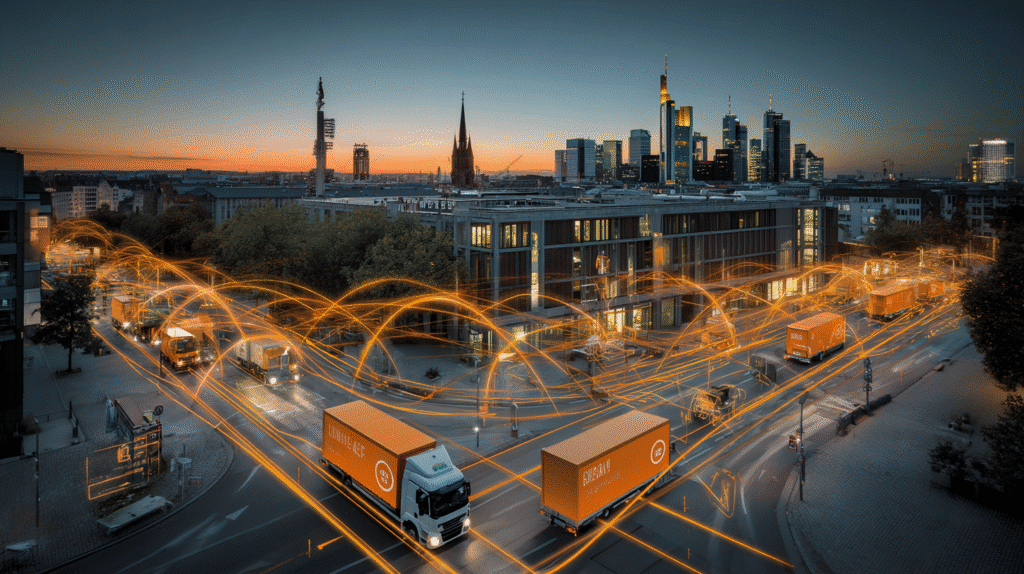
Reduce empty runs and save fuel
With an AI-based tour planning and tour optimization empty runs can be significantly reduced. It ensures that the tours are optimally planned and that the transports are constantly optimized even during ongoing operations. This is achieved, among other things, through the combination of several shipments and the intelligent matching of freight and vehicle.
At the same time, AI-based tour optimization improves the efficiency and profitability of transports by minimizing the number of kilometers traveled and the delivery time and maximizing the capacity utilization of the vehicles. But the benefits of AI-based tour optimization go beyond just reducing empty runs.
It also helps to improve customer service by providing accurate delivery time predictions and responding flexibly to changes in the delivery schedule. It also enables better transparency and control over the entire delivery process, which in turn leads to higher customer satisfaction.
Contribution to sustainability
In addition, AI-based tour optimization can make a significant contribution to sustainability. By reducing unnecessary trips and maximizing vehicle utilization, it helps to reduce the CO2 footprint and minimize the environmental impact of the industry as a whole.
An AI-based tour optimization is a powerful tool to reduce empty runs and, more importantly, to improve the profitability and sustainability of transport management as a whole. The automation of the processes ensures a much more efficient scheduling.
Reduce empty runs through freight exchanges
Another important factor in reducing empty runs are freight exchanges. Freight exchanges are online platforms on which freight forwarders can post their free capacities and shippers can tender their transport orders. They are, so to speak, the virtual marketplaces of the logistics industry, which bring supply and demand together in an efficient and transparent manner.
By integrating a freight exchange, transport companies can ensure that they find a return load and minimize empty runs. Freight exchanges also enable better cooperation between transport companies. They can exchange their free capacities with each other, organize joint loads and use their resources more efficiently. This promotes a cooperative and sustainable environment in the industry and helps to increase overall efficiency and profitability.
Freight exchange connection in TMS
In opheo and LP2, dispatchers fill free capacities in a structured and fast manner: orders can be transferred with a click to defined service provider circles or connected exchanges, return loads and additional freights are transparently evaluated.
Key figures such as detour kilometers, total costs, time windows and potential contribution margin are relevant for the decision – all at a glance. LP2 also offers a portal-based awarding and auction process with which offers can be compared and awarded according to rules; opheo simultaneously makes suitable return loads visible and prioritizes economic matches.
In combination with AI-supported evaluation, the team measurably reduces empty kilometers, increases utilization and shortens the reaction time in day-to-day business.
Reduce empty runs
In summary: The reduction of empty runs is a central challenge in transport logistics, which can be successfully mastered through the integration of AI-supported tour optimization, freight exchanges and modern transport management systems. The application of these technologies not only helps to increase efficiency and profitability, but also makes a significant contribution to the sustainability and ecological responsibility of transport companies.
With Solvares Logistics software solutions opheo and LP2, you can take the control of your fleet operations to a new level: AI-powered dispatch identifies opportunities for return loads, evaluates economic alternatives, and suggests the best sequence of stops, immediately effective against empty kilometers. The result: greater capacity utilization, more reliable adherence to schedules, and lower costs per tour. Companies that consistently use AI for empty runs combine strategic planning with operational excellence and achieve measurable effects, from the first tour to the final billing.
You don’t want to wait any longer and finally avoid empty runs? Then let’s talk about your transport management!